|
|
We are now faced with the fact that tomorrow is today. We are confronted with the fierce urgency of now. In this unfolding conundrum of life and history there is such a thing as being too late. Procrastination is still the thief of time. Life often leaves us standing bare, naked and dejected with a lost opportunity. The “tide in the affairs of men” does not remain at the flood; it ebbs. We may cry out desperately for time to pause in her passage, but time is deaf to every plea and rushes on. Over the bleached bones and jumbled residue of numerous civilizations are written the pathetic words: “Too late.”
—Martin Luther King, Jr. (Speech delivered April 4, 1967) |
|
|
A New Global Order: On Post-Neoliberal Globalization |
|
|---|
|
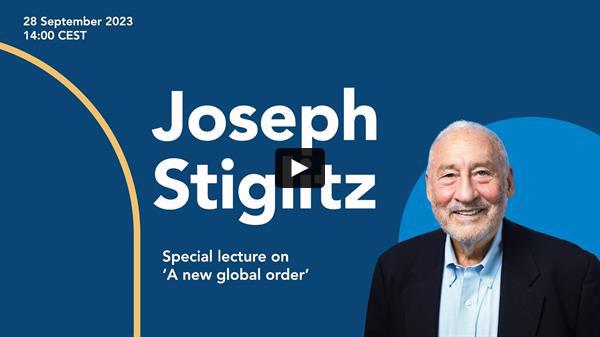
Join Nobel Prize laureate Joseph Stiglitz as he explores a new multilateralism that differs from the current neoliberal framework, offering an alternative basis for global cooperation. Recent years have dealt a fatal blow to the international economic order based on neoliberalism that has prevailed for the last half century. Economically, growth has been slower and inequality higher than earlier. The 2008 financial crisis exposed the instability of the system, the pandemic, with vaccine apartheid, showed that borders do matter, and the post-pandemic inflation demonstrated the market’s lack of resilience.
With the United States refusing to allow the appointment of appellate judges at the World Trade Organization and with its new industrial policies running roughshod over principles of a level playing field, the rules-based international trading system is in shambles, with a new geopolitics dividing the world into blocs, and countries de-risking their trade and financial systems.
Yet, climate change and pandemics require global cooperation. This talk explores a new multilateralism, an alternative to that based on neoliberalism, which might provide the basis of that cooperation, one that in key ways looks markedly different from the current global regime.
|
|
|---|
|
|
This article discusses the literature on neoliberalism for identifying a “minimum common core” that warrants preserving this concept. The author argues that neoliberalism entails an ideology and a political practice that aim to subordinate the state and all social domains to the market—to its logic and to the economic powers within it—thereby undermining democracy. This conceptualization emerges as a “common lowest denominator” among many otherwise incompatible scholarly definitions of neoliberalism, reflects central neoliberal ideas, and illuminates crucial features of contemporary neoliberal society. The author discusses the implications of this interpretation for established democracies and for those countries that experienced democratization processes during the neoliberal era.
_
|
|
|---|
|
|
|
Keywords and meta-markers: neoliberal ideas; contemporary neoliberal society; market fundamentalism; market citizenship; marginalization of democracy; governmentality; postneoliberalism |
|
Source:
Laruffa, Francesco. (2023).
Making Sense of (Post)Neoliberalism. Politics & Society, 0(0).
https://journals.sagepub.com/doi/10.1177/00323292231193805
|
|
|---|
|
|
|
|---|
|
| |
This open-access article analyzes the role of law and legal theory at major transition points in capitalism, particularly the Gilded Age and the rise of neoliberalism. Repeatedly, in all these battles, academics and judges harnessed legal theory and transposed the broader emerging ideological trends of the professional and managerial class to legitimate and contest the newly emerging, often more exploitative relations. The article ends with implications for the design and justification of a post-neoliberal regime.
_
|
|
|---|
|
|
|
Keywords and meta-markers: capitalism; legal theory; law and political economy; institutional political economy; institutional logics |
|
Source:
Benkler, Y. (2023).
Structure and Legitimation in Capitalism: Law, Power, and Justice in Market Society.
Available at SSRN: https://ssrn.com/abstract=4614192
|
|
|---|
|
|
|
|---|
|
| |
Entrenched systems see new ideas and logics as threatening and even incomprehensible. We’re at an impasse today because contemporary institutions keep bringing the same mindset to solving problems that need some fresh and strikingly different approaches. The many problems afflicting agriculture and the food system today are fundamentally similar to those afflicting the rest of society. They are just another theater for rentier capitalism, which relies on market/state collusion, extractivism of nature, and systemic precarity for many ordinary people.
What is most needed is creative experimentation in developing a new, more wholesome paradigm. This presentation focuses on how we can make some ambitious, creative leaps forward, and how the commons – as a discourse, social practice, ethic, and worldview – can be very helpful in meeting this challenge. The presenter explains how the commons can provide a strong, coherent framework – and many actual, practical projects – that open up some promising vistas of change.
_
|
|
|---|
|
|
|
Keywords: parallel polis; changemaking; localized alternatives to capitalist Big Ag; politics of belonging; economics of sufficiency; bioregional movement |
|
Source:
Bollier, David. (2024, January 5).
Commons and Commoning: A Progressive Vision of a Good Society. [Conference presentation]. Oxford Real Farming Conference, Oxford, United Kingdom.
Repost on Grassroots Economic Organizing:
https://geo.coop/articles/commons-and-commoning-progressive-vision-good-society
_ |
|
|---|
|
|
|
|---|
|
|
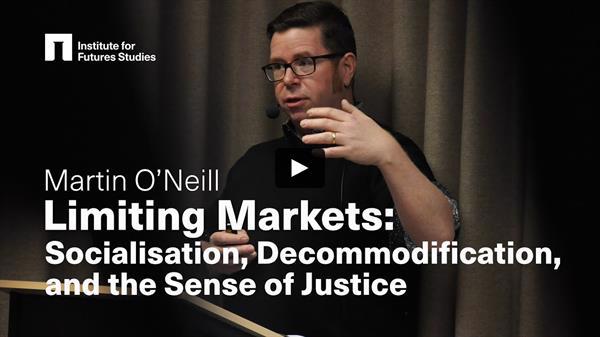
The following lecture by British political philosopher Martin O’Neill addresses the questions of the size of the public sector in a just society, and the range of goods and services which should be decommodified, and provided to citizens outside of market relationships, in such a society. O’Neill examines some of the different answers given to these questions by (a) liberal egalitarians (particularly Rawls) and (b) social democrats and democratic socialists (particularly Esping-Andersen). Then, making use of the work of theorists including Waheed Hussain and Ralph Miliband, the philosopher examines the plausibility of a ‘left Rawlsian’ position, which would marry socialist insights about the functions of public provision with a liberal egalitarian account of the principles of justice, in order to defend an institutional model of a just society which would embody a form of liberal democratic socialism. |
|
|---|
|
|
Multiple global crises—including the pandemic, climate change, and Russia’s war on Ukraine—have recently linked together in ways that are significant in scope, devastating in effect, but poorly understood. A growing number of scholars and policymakers characterize the situation as a “polycrisis.”
This article offers a theoretical framework to explain the causal mechanisms currently entangling many of the world’s crises. In this framework, a global crisis arises when one or more fast-moving trigger events combines with slow-moving stresses to push a global system out of its established equilibrium and into a volatile and harmful state of disequilibrium.
The authors identify three causal pathways—common stresses, domino effects, and inter-systemic feedbacks—that can connect multiple global systems to produce synchronized crises. Drawing on current examples, the authors show that the polycrisis concept is a valuable tool for understanding unfolding crises, generating actionable insights, and opening avenues for future research.
_
|
|
|---|
|
|
|
Keywords and meta-markers: polycrisis; metacrisis; long emergency; complexity; intersystemic feedbacks; hyper-connectivity; production of harm; destabilization of ecospheric systems; VUCA; crisis interaction between multiple systems; post-Holocene transformation |
|
Source:
Lawrence, M., T. Homer-Dixon, S. Janzwood, J. Rockström, O. Renn, and J. F. Donges. 2023. “Global Polycrisis: The causal mechanisms of crisis entanglement.” Version 1.0. Pre-print. Cascade Institute.
https://cascadeinstitute.org/technical-paper/global-polycrisis-the-causal-mechanisms-of-crisis-entanglement/
_
|
|
|---|
|
|
|
|---|
|
| |
This review explains how and why the United States has systemically high poverty. Descriptive evidence shows that U.S. poverty is (i) a huge share of the population, (ii) a perennial outlier among rich democracies, (iii) staggeringly high for certain groups, (iv) unexpectedly high for those who “play by the rules,” and (v) pervasive across various groups and places. This review then discusses and critiques three prevailing approaches focused on the individual poor rather than the systemically high poverty: (i) behavioral explanations “fixing the poor,” (ii) emotive compassion “dramatizing the poor,” and (iii) cultural explanations both dramatizing and fixing the poor. The essay then reviews political explanations that emphasize the essential role of social policy generosity, political choices to penalize risks, power resources of collective political actors, and institutions. This review demonstrates a long emerging but ascending and warranted shift away from individualistic explanations of the poor toward political explanations of poverty.
_
|
|
|---|
|
|
|
Keywords and meta-markers: poverty measurement; systemically high poverty; political explanations of poverty; social insecurity; politics of stigmatization and human insecurities; socioeconomic achievement; individualistic problem of persons; failures of awareness |
|
Source:
Brady, David. (2023). Poverty, not the poor.
Science Advances, 9(34), eadg1469
https://www.science.org/doi/10.1126/sciadv.adg1469
_
|
|
|---|
|
|
|
|---|
|
|
NB: This publication is not optimized for small-resolution screens and mobile devices, and it may not render equally well in all email clients and applications. For the best reading experience, we recommend viewing this knowledge synthesis in the web browser of your desktop computer, notebook, or tablet. Gmail and some other email clients may clip the displayed part of the publication. To enjoy the full issue, click on the “view entire message” link at the bottom of this message or select the “view this email in your browser” option at the top.
This bulletin contains 24 unique entries (textual, graphic and video materials), generally referenced by titles in bold font. It will be easier for you to access the full content of the issue by knowing this, even if your email program ends up clipping the displayed part of the publication. Note that we usually place event announcements and links for open-access book downloads toward the end of the bulletin. |
|
|---|
|
| | |
The helplessness of the UN and NGO workers amid the ruins of Gaza bring to mind those environmental activists who try to clean up the oceans a teaspoon at a time – faced with the impossibility of alleviating what they should instead be preventing from taking place. Just as the will of governments to deal with the climate emergency is expressed by organising conclaves in the world’s biggest oil potentates, attended by 2,456 lobbyists from the fossil fuel industry, and presided over by presidents of its largest companies, so too it is the president of the state that organizes airlifts of weapons to Israel that urges ‘restraint’ and warns against ‘indiscriminate bombing’. According to CNN, at least 22,000 of the 29,000 bombs dropped on Gaza up to 13 December were supplied by the USA. This is a close cousin of greenwashing: we supply the bombs and we feel sorry for their victims. Call it compassionate bombing... >>>
By Marco D’Eramo (Sidecar, January 11, 2024) |
|
|---|
|
|
|
|
_
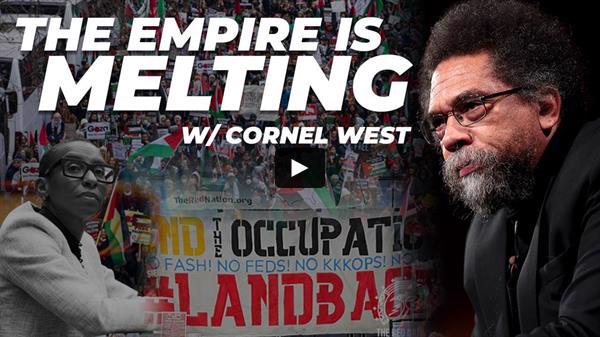
American philosopher, theologian and public intellectual Cornel West is back on The Red Nation Podcast. He discusses the anti-Palestinian racism at Harvard, the genocide in Gaza, LandBack, and the soulcraft of spiritual resistance to the deep calamities facing humanity and the world.
_ |
|
|---|
|
|
|
|---|
|
| |
The lengths that the Israeli government has gone to are characteristic of settler colonial states. All of them, including the U.S. and Canada, have acted violently to neutralize or exterminate the resident Indigenous people.
That is what this genocidal interlude is all about. It is an effort to realize the goals of maximal versions of Zionism, which can only succeed by eliminating the Palestinians as rightful claimants. It should not be forgotten that in the weeks before the Hamas attack, including at the U.N., Prime Minister Benjamin Netanyahu was waving a map of “the new Middle East” that had erased the existence of Palestine. >>>
By Richard Falk (Common Dreams, 1/11/2024) |
|
|---|
|
|
|
Javier Milei’s warm welcome at this year’s World Economic Forum (WEF) in Davos was the latest stage in the seemingly baffling rise of radical right-wing libertarianism to political respectability. The recently elected president of Argentina, who brandished a chain saw during campaign rallies to symbolically cut through regulatory red tape, has become the new hero figure of the libertarian right.
We should see libertarianism’s bid for the political mainstream in relation to the development of its closest ideological ally, neoliberalism, alongside which it emerged as a right-wing phenomenon in the 1930s. The fact that libertarian leaders are gaining popularity just as the neoliberal era appears to be coming to an end points to a consolidation of market-radical ideologies rather than their dissolution. >>>
By Dennis Kölling (Jacobin, 2/4/2024) |
|
|---|
|
|
|
|---|
|
| |
Neoliberalism is the disease that keeps on killing
Did you know the neoliberal economic gospel we live under today is a deliberate misinterpretation of the original theory? In her new book,
The Big Myth: How American Business Taught Us to Loathe Government and Love the Free Market, historian of science Naomi Oreskes shows how a group of American plutocrats distorted the conservative teachings of Friedrich von Hayek’s theory of neoliberalism in order to plunder the world’s resource, unleash the markets, and undermine federal power.
On this episode of the
Planet: Critical podcast, Naomi joins its host Rachel Donald to offer an incisive and brutal summary of why our world is in crisis, detailing the criminal avarice of these plutocrats; how institutions, lobbyists and corporations continue to undermine democracy; and why a renewable world threatens the powers that be. This insightful explanation shows why the climate crisis is not a scientific problem, but a political, economic and social issue, with Naomi revealing tactics civilians used throughout history against the destructive elite.
>>> Excerpt from Naomi Oreskes’ “The Big Myth“ (Harvard Gazette, March 3, 2023)
|
 |
|
|---|
|
|
|
The world faces twin crises of climate breakdown and runaway inequality. The richest people, corporations and countries are destroying the world with their huge carbon emissions. Meanwhile, people living in poverty, those experiencing marginalization, and countries in the Global South are those impacted the hardest. Women and girls, Indigenous Peoples, people living in poverty and other groups experiencing discrimination are particularly at a disadvantage.
The world needs an equal transformation. Only a radical reduction in inequality, transformative climate action and fundamentally shifting our economic goals as a society can save our planet while ensuring wellbeing for all.
_
|
|
|---|
|
|
|
Keywords and meta-markers: carbon emissions, extreme wealth, carbon footprint of Global North, loss and damage, just societal transformations |
|
Source:
Khalfan, A., Nilsson Lewis, A., Aguilar, C., et al. (2023).
Climate Equality: A planet for the 99%. Oxford, UK: Oxfam International.
https://policy-practice.oxfam.org/resources/climate-equality-a-planet-for-the-99-621551/
|
|
|---|
|
|
|
|---|
|
| |
This report is based on findings from a nationally representative survey –
Climate Change in the American Mind – conducted by the Yale Program on Climate Change Communication and the George Mason University Center for Climate Change Communication. Interview dates: October 20 – 26, 2023. Interviews: 1,033 adults (18+). Average margin of error: +/- 3 percentage points at the 95% confidence level.
Majorities of Americans think global warming is affecting many environmental problems in the United States, including extreme heat (75%), droughts (71%), wildfires (70%), air pollution (66%), water shortages (66%), flooding (66%), rising sea levels (66%), hurricanes (64%), reduced snow pack (61%), tornados (61%), agricultural pests and diseases (59%), water pollution (58%), and electricity power outages (57%).
_
|
|
|---|
|
|
|
Keywords and meta-markers: impacts of global warming, perceived risks of global warming, emotional responses and mental health, fatalism |
|
Source:
Leiserowitz, A., Maibach, E., Rosenthal, S., et al. (2023).
Climate Change in the American Mind: Beliefs & Attitudes, Fall 2023. Yale University and George Mason University. New Haven, CT: Yale Program on Climate Change Communication.
https://climatecommunication.yale.edu/publications/climate-change-in-the-american-mind-beliefs-attitudes-fall-2023/
|
|
|---|
|
|
|
|---|
|
| |
There is a gap between concern about environmental degradation such as climate change and effective action taken against the forces that drive degradation. This open-access paper argues that real helplessness, a social condition producing powerless, stupefied, and repressed actors, is a fortified barrier between climate concern and effective climate action.
Political-economic analysis has theoretical and methodological implications for environmental social science and helps explain a current conundrum in critical sociology: Why are alternatives to a system that drives climate change and other catastrophic risks still seen as unrealistic? We suffer from a political-economic system impervious to transformation before we suffer from a lack of alternative ideas.
_
|
|
|---|
|
|
|
Keywords and meta-markers: climate inaction; powerlessness in climate politics, reification, hegemonic neoliberalism, cognitive control by the culture industry, real helplessness; repressive state apparatus |
|
Source:
Gunderson, R. (2023).
Powerless, Stupefied, and Repressed Actors Cannot Challenge Climate Change: Real Helplessness as a Barrier Between Environmental Concern and Action. Journal for the Theory of Social Behaviour, 53(2), 271–295.
https://onlinelibrary.wiley.com/doi/full/10.1111/jtsb.12366
|
|
|---|
|
|
|
|---|
|
|
On this episode of
The Great Simplification podcast, its host Nate Hagens is joined by climate researcher Leon Simons to unpack recent trends in global heating during 2023 and potential explanations and subsequent projections for the coming year. While the connection between human emitted greenhouse gasses and global warming is scientifically agreed upon, the other complexities and feedbacks of our climate system are still just beginning to be understood.
Today, Leon theorizes on the intensity of aerosol masking from particulates such as sulfur, based on the connection between recent changes in marine fuel sulfur requirements and corresponding climate data. How will the global trend towards aerosol reductions affect near and long term global heating? What does this catch-22 mean for potential future climate action and policy? How should we be thinking about creating a more simplified global system in response to the unknown unknowns of our potential future climate? |
|
|---|
|
|
“When you have reached the edge of an abyss, the only thing that makes sense is to step back.”
—Alwyn Reese (1911-1974), Welsh geographer and social anthropologist |
|
|
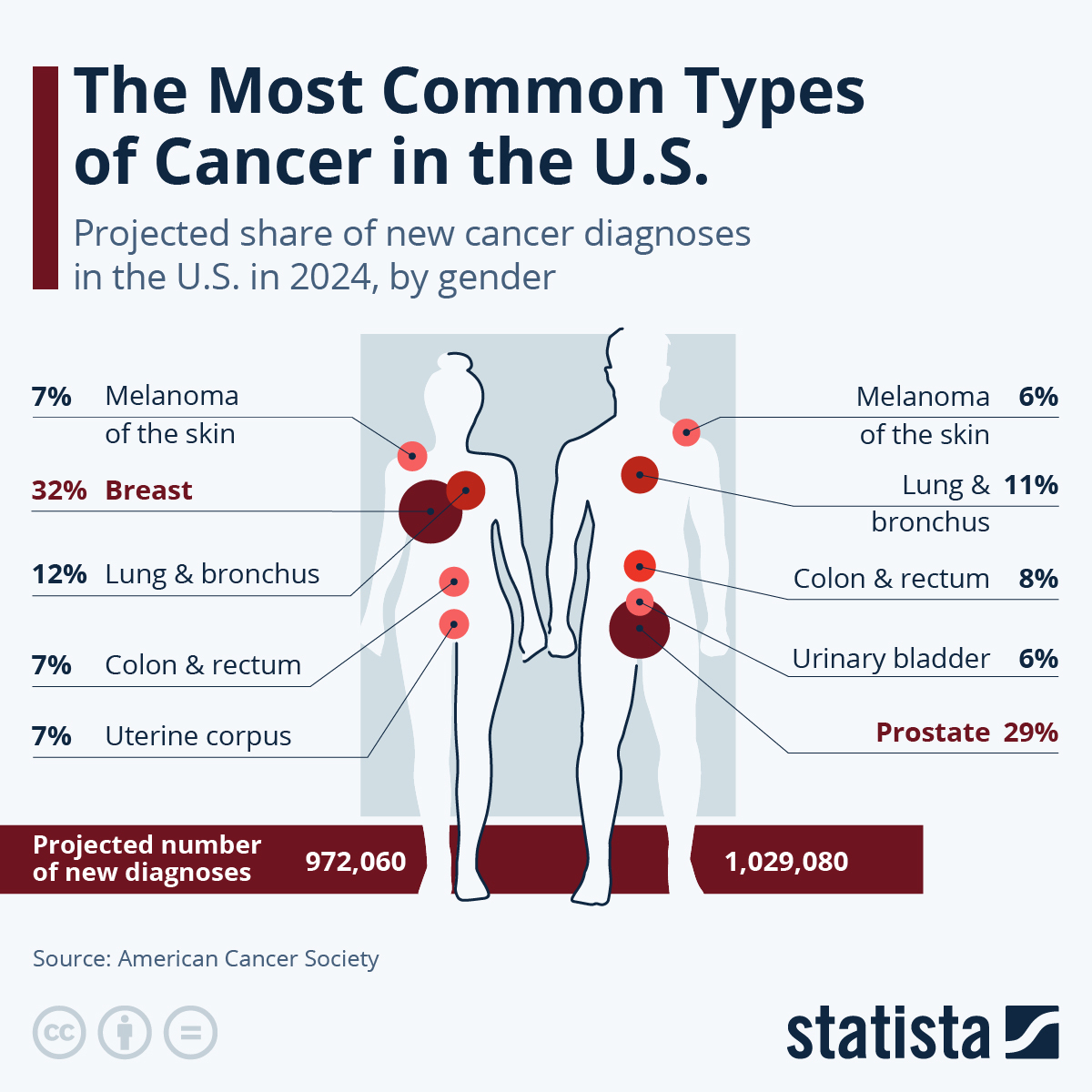
New estimates from the WHO’s International Agency for Research on Cancer predict a 77% increase in cancer cases globally by 2050. The document released on 02/01/2024 points to air pollution as one of the key factors driving the expected increase in cancer rates. |
|
|---|
|
|
Plastic pollution is one of the most serious environmental crises facing the world today. Underpinning this crisis is a campaign of fraud and deception about the recyclability of plastics that fossil fuel and other petrochemical companies have created and perpetuated for decades.
Through new and existing research, “The Fraud of Plastic Recycling” report shows how Big Oil and the plastics industry have deceptively promoted recycling as a solution to plastic waste management for more than 50 years, despite their long-standing knowledge that plastic recycling is not technically or economically viable at scale. Plastics industry falsely promoted—and continues to promote—plastic recycling as a means to achieve a “circular economy”.
_
|
|
|---|
|
|
|
Keywords and meta-markers: corporate fraud and deception; false innovation claims; regulatory failure; throwaway culture; misleading educational materials; long-term environmental degradation; human health threats; chronic toxicity |
|
Source:
Allen, D., Spoelman, N., Linsley, C., & Johl, A. (2024).
The Fraud of Plastic Recycling. Washington, DC: The Center for Climate Integrity.
https://climateintegrity.org/plastics-fraud
|
|
|---|
|
|
|
|---|
|
| |
|
|
|
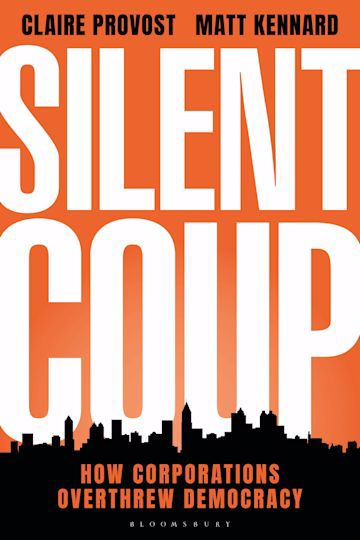
As European empires crumbled in the 20th century, the power structures that had dominated the world for centuries were up for renegotiation. Yet instead of a rebirth for democracy, what emerged was a silent coup – namely, the unstoppable rise of global corporate power.
Exposing the origins of this epic power grab as well as its present-day consequences,
Silent Coup: How Corporations Overthrew Democracy is the result of investigative reports from 30 countries around the world. It provides an explosive guide to the rise of a corporate empire that now dictates how resources are allocated, how territories are governed, and how justice is defined.
|
|
|---|
|
|
|
 |
Consilience Learning Circles (formerly
Consilience Think Tank) is now a testing ground for our new learning and critical-thinking series being constructed at the intersection of philosophy, political science, heterodox economic theory, systemology, environmental thought, and traditional ecological knowledge, as well as utopian, cultural, and design studies. These open-ended series encourage a transdisciplinary dialogue on ends, ways, and means of deep green transformation of societies toward post-capitalist and post-liberal ecological civilization.
The series is intended to build the capacity for practical emancipatory interventions of active citizens in the fields of human activity locally and globally, in addition to cultivating a strong interpretive potential and serving as a hermeneutic and public-education platform outside neoliberal academia’s programmatic, ideological, and operational confines.
The 2024-2025 featured series are:
-
Metanoia (ongoing)
-
Oikonomia (soft launch scheduled for summer 2024)
-
Paideia (ongoing)
-
Phrónēsis (scheduled for winter 2024/2025)
-
Technê (scheduled for spring 2025)
In future issues of
Metascope, we will explain the function and structure of each of these series. Their syllabi are iteratively designed and modified as our participatory action inquiry progresses. Retiring the “think tank” part of the original name of our transdisciplinary knowledge venture underscores our deepening commitment to genuine democratization of knowledge and decolonization of science, alongside our experimentation with innovative modes and forms of intersectoral, collaborative learning firmly rooted in robust civic values and social solidarity.
To request the spring schedule of the co-learning sessions, contact us at think@hawaii.edu. |
|
|---|
|
|
|
This publication and the new
Consilience Learning Series are co-produced by IMUA Labs* and the People’s Knowledge Institute (PKI), a critical social learning system and an experimental vehicle for integral, post-formal education and transformational community research.
The central goal of our publications, knowledge-sharing streams and collaborative learning exercises is to cultivate civic intelligence, systemic literacy and cognitive competences essential for living in a complex, dynamic world, and to elevate the community’s possession of truth, knowledge, and rational beliefs that support the ecological way of life.
As a collective intelligence initiative, we welcome a diversity of ideas and epistemic pluralism. Thus, the arguments expressed in our knowledge syntheses, bulletins, and event announcements do not necessarily reflect the views of IMUA Labs or PKI. Should you spot a data error, a missing critical topic or issue, or an instance of faulty reasoning in our transdisciplinary publications, please submit your feedback to our science communication specialists at
imualabs@hawaii.edu. |
|
|---|
|
*IMUA Labs @UH is a short name of the IMUA Scholarly Society for Epistemic Innovation, Integral Studies, and Transformational Research |
|
|---|
|
|
|